
September 20th, 2026 – Los Angeles, CA
When it comes to blending inspirations, Los Angeles-based band 16 Underground seemingly indulges in subconscious experimentation. From the hybridization of trip-hop, electronic pop, and many more reminiscent genres, the group proves that simply doing what they love is fuel enough for the sounds they are creating.

Photography by Amanda Hoss (@crosstitcheart)
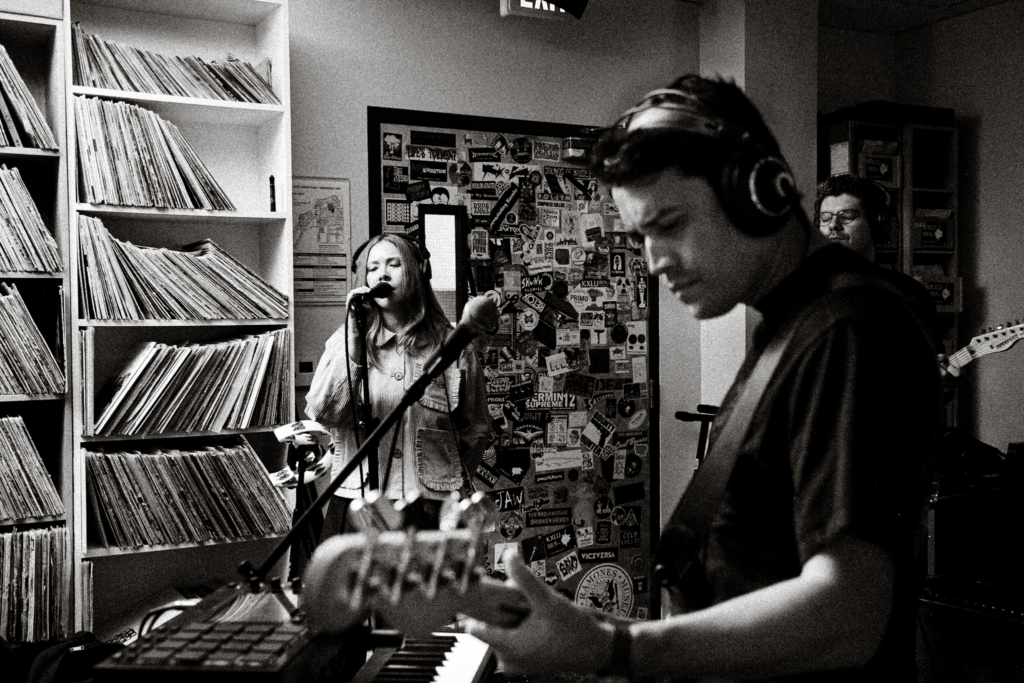
In mid-August, 16 Underground dropped their newest EP, Without A Trace, showcasing their eclectic sonic palette to listeners. Kicking off the five-song EP with the ultra-synthy “Glimpse of You,” the band proves right away that freedom in composition is key to their blissful sound. I sat down with the four of them among unplugged amplifiers and stray chords, directly following their KXLU 88.9 FM live session with station DJ Thomas Davies for his show Catalyst @catalyst._.radio (Mondays 10 AM – 12 PM, session airing soon).
Made up of Andres Sanchez (guitars), Christian Ramos (drums), Edward Barraza (guitars, bass, keyboards), and Hannah Campbell (vocals), 16 Underground has grown together as four artists over the years. Sanchez tells me how a few of them “started playing in punk and hardcore bands when [they] were teenagers and all throughout [their] 20s,” and eventually “just started listening to different stuff and it evolved into what [they’re] doing now.”


Photography by Amanda Hoss (IG: @crosstitcheart)
I ask the four of them about their personal evolutions as musicians, and how growing into a certain sound has impacted the way they create. Ramos gives some insight. “When we were younger, we played really aggressive, fast-tempo music. Over time, you sort of mellow out a little bit and play what you like. You find your thing.”
In order to “find their thing,” the collaboration that came alongside the start of 16 Underground was vital. Since each member came from different musical backgrounds and interests, the band’s sound spans genres and draws on a wide array of influences. “We all listen to different music,” Campbell tells me. “All of those just come together to mold what we make today.”
“We love Garbage. You can hear some of that in there. The New York band Ivy. I think that was like a central kind of starting point, for sure.”
The consistent experimentation throughout 16 Underground’s discography leads me to wonder about how they define themselves as artists in this new wave of electronic pop. I ask the four if they see themselves as innovators in what they do.
Ramos shakes his head right away. “I think, personally, that there’s nothing new under the sun,” he tells me. The others agree. “I think that innovation is just building off of what other people have done. Innovation doesn’t just come from thin air.”
“I definitely don’t see myself as an innovator,” Campbell states. “Maybe in an unconscious way. It’s just about filtering everything that I’ve ever listened to or seen. We’re just reinterpreting.”
On that note, I ask the band about specific inspirations. With 16 Underground being credited for fusing genres such as vintage trip-hop, lo-fi, shoegaze, and emo— they’ve clearly found a formula that works. Understanding that each of them brings something different to the table, I am curious to know exactly what those components are.
“There are certain bands that we pull from for sure, but our musical influences are so broad. If we have an idea, it could’ve come from something any of us has heard. When it comes to composition, there are really no rules.”
“Taking risks is a super important part of making music. In putting stuff out there, you’re not always sure it’s gonna hit right at the end of the day. You do it because you love it. Because it makes sense to you. It’s a risk just putting it out there.”
Campbell tells me that risk-taking is less intentional and more of a musician’s subconscious effort. In another way, the four of them see composition as a free, artistic exploration— they create whatever sounds good in the moment, blocking out exterior voices. They never consider what kind of music they “should be making,” or what they think might receive the best reception. To 16 Underground, creating music is purely an enjoyable, expressive craft.


Photography by Amanda Hoss (IG: @crosstitcheart)
On the acceptance of the L.A. scene, Campbell tells me about how there is always room to change and grow within this city’s vast music community. “Our scene is very supportive; we’re never trapped into one specific sound. If we want to do a slow song, or a faster song, or even a dance song, we always have room to experiment.”
“What’s great about L.A. is that there are so many different genres, and when you’re in the scene, you become friends with so many different people. There’s no box in L.A. Everyone’s doing such cool stuff; so many crazy blends of music.”
In the L.A. scene, it seems that sonic diversity is key. “ Here, we don’t care for any of those typical boundaries,” Barraza states. “We’ve played with shoegaze bands, trip-hoppy stuff, electronic stuff. We often play with heavy and hardcore groups. We all learn from each other.”
When it comes to Without A Trace, 16 Underground believes that artistic autonomy is a large factor in the sounds that came together to create the new EP. Whether that manifests in the collaboration of group practices, improvisation in the recording booth, or the open-minded headspace they bring into the room— all of these liberties aid in their composition. “Everything we do is super collaborative, whether that be everybody bringing in ideas or just doing a late-night jam session,” Campbell highlights.


Photography by Amanda Hoss (IG: @crosstitcheart)
“’Angel (On the Run)‘ was written on a rainy day in the studio, and we had our windows open. I feel like it really set the vibe of what that song was gonna be. Andy was doing his guitar riffs alongside the slower drums, and then the synth that Edward put on over it. It was just really moody and gloomy. It’s definitely a fall song.”
The ability to visualize the world around them in creating a song’s mood is an important one for 16 Underground. Spontaneity helps the ideas flow, so that later on, the track might evoke an authentic feeling rather than a fabricated one. There is truth in Without A Trace— it runs throughout each ambient track.
As of late, 16 Underground has travelled across state borders to play their music to east and west coast crowds. Hitting music hotspots such as San Francisco, San Diego, and New York City, they’ve been able to observe the eclectic groups that run through each city scene. I ask about their New York show at Nightclub 101.
That was an awesome show,” Barraza says. “Like, sold out. I felt like people were really digging us, you know.”
Campbell adds on. “I’m always surprised at how many hardcore guys like 16 Underground. But we love it. The community at our shows is great. That’s something I’m always surprised by. I feel like there are people that you wouldn’t expect to like our music.”
Barraza laughs. “I’m just surprised that people like it at all.”
16 Underground perfects the necessary skill of making music for no one in particular. You throw something out there, and hope that it sticks. Sometimes it holds, and sometimes the reception is less ecstatic— but to Campbell, Ramos, Barraza, and Sanchez, the best part of creating music is simply the experimental freedom of making anything at all.
“Even if nobody liked our stuff,” they state, “we’d still be making music. That’s just part of it.”
Photography by Amanda Hoss (IG: @crosstitcheart)
Stream Without A Trace here!
Connect with 16 Underground on socials!
✰ Keep up with KXLU! ✰ Daily ticket giveaways & updates ✰