
October 21st, 2026 – Los Angeles, CA
In this interview, Jake Cousino of The Sonic Temple sat down with legendary voice actor, comedian, and musician Tom Kenny. We discussed Tom’s history with music, the formation of the Hi-Seas, and what it means to play live shows. Tom Kenny and the Hi-Seas are playing at Alex’s Bar on Saturday, October 24th.
Watch the full interview here
Jake: Tom, thanks for being here with KXLU 88.9 FM.
Tom: Great to be here with you, Jake. Thanks for having me.
Jake: We just want to talk a little bit about Tom Kenny and the Hi-Seas. You’ve got some shows coming up. Let’s start with your musical influences. Tell us about your history with music, some influences, punk rock stuff, and things like that.
Tom: I was fourteen years old in 1976, which was when that first wave of New York City punk rock hit. I was living in Syracuse, New York, which was a college town, so even though it was four or five hours out of New York City, you still got all those CBGB bands coming through Syracuse to play.
I was lucky enough to see all those bands, the Ramones, David Johansen of the New York Dolls, the Dead Boys, and all kinds of other bands when they came through Syracuse. Syracuse also had a really good scene of homegrown rock and roll itself. Like a lot of blue-collar cities, it’s just blues and rock and roll, muscular music. When New Wave and punk rock hit, Syracuse was no exception. There was a great band called the Flashcubes who were kind of my teenage idols.
They were a band that did their own thing when punk rock was brand new. Everybody was doing prog rock and 20-minute-long guitar solos, and here were these guys who were older than me, but it seemed doable. I joined a band with a bunch of older guys called the Tearjerkers when I was still in high school.
Once I started doing stand-up comedy, sketch comedy, and on-camera work, and making a living doing that, music took a back seat because you only have so many hours in the day.
Fast-forward to the SpongeBob days, and the SpongeBob people needed some original songs written for the show. My good friend Andy Paley, a really talented guy who’s worked with the Ramones, Madonna, Brian Wilson, and a whole lot of other people, and I started writing songs for SpongeBob. Through musical contacts we all had, we formed a band that was playing this SpongeBob music.
Out of that grew the Hi-Seas. We thought, instead of just doing cartoon music, why don’t we play old R&B and make it sound new again? R&B, soul, blues with punk rock energy. Why not? Let’s do it.
Before we knew it, there was a 12-piece band, 11 plus me, which is kind of insane. We’ve been playing for many years now. It’s been a slow roll, but it started with us opening for other bands and occasionally playing after-parties for awards shows and things like that.
Now we’re playing full-on clubs like Alex’s Bar in Long Beach, the venerable Alex’s Bar. I think we’ll probably sell it out. It’s a 250- to 300-seat place. We sold it out last time, along with the band we’re on the bill with, the Cineramas, who are fantastic and local.
That’s the thumbnail version of where the Hi-Seas came from, but it’s all rooted in my love of roots music and fun, jumping rock and roll. Not just rock and roll, but rockabilly, country, Cajun, Zydeco, Western swing, soul, gospel, and everything.
My co-founder Andy Paley, who unfortunately passed away from cancer in 2024, was the same way. We were simpatico, and we were both musical omnivores. We liked all kinds of stuff.
Andy’s been gone a couple of years now, and the band is still rolling on. It’s kind of a testament to him and a tribute to him and this crazy boulder that he rolled up the hill with a little help from me, but mostly him. There you go. Bob’s your uncle.
Jake: There you go. How does picking a setlist for a Tom Kenny and the Hi-Seas show work? What do you want the audience to take away from the music you play?
Tom: We know a lot of songs, and we’ve played together enough that we like to switch it up a lot. We’re always learning new stuff. There’s a rehearsal you’re at tonight that’ll start in a little while, and we’re learning a couple of new numbers that we’ll probably debut if these gigs sound good.
It’s really about reading the room, maybe even ahead of time, trying to figure out what the room will be and figuring out those highs and lows.
We want the audience to walk away having had a great time, thinking, “Wow, I left my troubles at the door, came in, jumped around like a maniac, danced and sweated, and the band jumped around like maniacs, danced and sweated, and it was this communal experience.”
That’s what music should be. We like playing together, but we’re really playing for the audience.
We look at the audience as collaborators with us. We’re all in this together. Let’s have a great time tonight, put your cell phones down, and let’s go crazy. Let’s have fun and see where the music takes us.
It’s really a blast. People come out of it saying, “Wow, that was really cathartic. I needed that more than I knew I needed it.” They say, “That was just pure stupid fun. I loved it.”
We sprinkle in a couple of SpongeBob numbers, too, because millennials grew up with SpongeBob. It’s a nice little lagniappe for them to give them.
To us, it’s a communal effort. The band is a communal effort between these twelve people, and we look at the audience as our co-conspirators in this mission to make fun happen.
Jake: I wanted to get into the art of performance. Whether it’s acting, voice acting, comedy, or live music, what does that energy feel like and bring to you?
Tom: They’re all really different, as they sound like they would be, but they’re really all the same. You have to be fully invested in it, or otherwise, why bother?
Whether it’s a voiceover performance in a cartoon, a band set, or some sketch on Mr. Show with Bob and David, you just have to go full throttle, balls to the wall, and do it. Invest yourself in it totally.
That’s never a problem for me because I love the music we do, especially with the band, and I like putting it out there for people.
It’s a style of music that’s less ubiquitous in the world today than it was a whole bunch of decades ago. A lot of people have never heard or seen a band like this live, with a full horn section and backup singers. But it’s still rock and roll.
It’s fun to put that out there for people. I wouldn’t say it’s easy, but it’s worth it. It’s fun, and people really seem to enjoy it.
People of all ages come up to us. Old record collectors say, “I can’t believe you played that song. I never thought I’d hear a band play that song live. That is a deep, deep cut.”
Then you have millennials who say, “I’ve never seen anything like this before. What do you call this music? What’s the label?”
Maybe as a residual effect, they’ll dig into this music a little deeper. Maybe a few of them will pay it forward and get interested in all this crazy stuff that blew my mind and warped my brain when I first heard it as a young teen, maybe even pre-teen.
I remember thinking, “Why does this hit me so hard? Why do I love it so much?”
Cartoons affected me the same way as a kid. Animation and rock and roll were the two things I loved the most, that moved me the most, and that I wanted to participate in the most.
I thought, if I could eke out a living doing some combination of those two things, one or both, that would be a dream come true. It actually happened. It’s a mind-blower every day.

Jake: It’s great that you’re able to combine both live music and cartoons in a live setting, with the SpongeBob songs and whatnot.
Tom: Everything’s a mashup. Those SpongeBob songs were written by Andy Paley and me. Again, it’s a nice testament to this friend and mentor who helped us launch this rocket ship years ago. It’s still orbiting. It’s still circling the Earth and going even faster than it did before.
It’s incredible because we don’t really have a record out. We don’t have a record deal, a label, or a publicist. We don’t have any of that stuff that a lot of bands do.
We just try to put on the best, most fun live shows we can and hope that word gets around. One person tells another person, that person tells two people, and those two people tell four people.
Hopefully, the people who had a great time will come back again, and the people who missed it will hear about how much fun it is, have FOMO, and come back the next time.
It’s fun. I’ve never really had any kind of strategy for anything in my career. I just followed interests I had, found out more about them, and tried to get better at them.
That whole 10,000-hours theory, that you can’t help but get better if you keep doing something over and over, applies whether it’s sports, playing a video game, or whatever it is. Due diligence often pays off, but sometimes it takes a while.
I always wanted to be a cartoon voiceover person since I was a little kid, but I didn’t book my first real cartoon voiceover job until I was thirty. I was trying the whole time.
In the meantime, I made a living as a stand-up comedian, wrote on things, and did on-camera work. I was always hustling and trying to learn, putting different tools in my belt so that when one thing isn’t happening, you can use those skills elsewhere.
That stood me in good stead. I also learned a lot from older, smarter people who were ahead of me on the path, whether voiceover people like Billy West, Frank Welker, and Rob Paulsen, or music people like the Flashcubes in Syracuse and Andy Paley out here.
Jake: It seems like learning as much as you can pays off, even when you’re not sure what might happen in the future.
Tom: It really never stops. People say, “You should teach a voiceover class,” or, “I teach a voiceover class. You should come in and be a guest lecturer and teach voiceover.”
I feel like I’m still learning. I don’t feel like I have the credentials to teach this stuff, even though I’m okay at it just through doing it for a million years. I still feel like I’m in my learning process.
The same thing applies to the band. We’re always figuring out how we can do a song a little differently or structure the show differently for maximum impact.
We’re just a bar band. We want to have a party. We set up, there’s a stage, a bunch of instruments, microphones, and we play.
Not that there’s anything wrong with it, but pop music today is kind of apples and oranges compared with what we do. A lot of times, you go to these big stadium concerts and there are dancers, laser shows, costume changes, and all that. It’s almost like going to see Cats on Broadway more than going to see a rock and roll show.
We want to be the corrective to that. There are still a lot of bands out there with the same aesthetic.
You just walk in, have a couple of beers or whatever you feel like drinking, alcoholic or otherwise, and the party happens. It’s just music and bodies. That’s it.
Jake: It’s like an energy.
Tom: It’s energy, right! Back and forth, exactly. When I’m on stage with the Hi-Seas, I feel this circuit happening where we’re putting out energy, the audience receives it, and then they give it back to us, which encourages us.
It builds and builds. It’s a nice, symbiotic relationship where I feel like we and the audience are doing something nice for each other. We’re helping each other out, lifting each other up, and having fun in a world that often isn’t that much fun, even in the best of circumstances, let alone the grim reality we’re all forced to inhabit now through no fault of our own.
We aren’t trying to be deep or profound with the songs. In fact, quite the opposite. But I think the feelings are deep and profound: happiness, sadness, loss, heartbreak, hope.
Tom: All of our songs have one or more of those things in them. They’re not deep lyrics where you’re thinking, “Whoa, man, let me parse the lyrics and see what he’s really trying to say.”
It’s just out there, very clear, very broad strokes. That’s what we like doing.
Jake: Right, and to that point about energy, what does playing a place like Alex’s Bar, a small, intimate venue, mean to you? We talked about having this conversation with the audience. What does that connectedness mean to you?
Tom: One thing I love about Alex’s Bar is that it’s been around for a while and has hosted, and continues to host, a lot of iconic, incredible bands.
I’m going to see the Mummies there on the seventeenth, the weekend before we play there. They’re old friends of mine.
What’s amazing is that, in a world where rock and roll venues, or live music venues, are owned by consortiums and conglomerates, Alex’s Bar really has an Alex. He’s there. It’s Alex of Alex’s Bar, and he’s fully invested. He’s a music fan.
Nobody puts on live music practically seven nights a week for years and years to make a zillion dollars, because you don’t. One thing I love about Alex is that he’s a fan.
It’s hard. It would be so much easier to have a different type of bar. The logistics of hosting music night after night, with bands, setups and teardowns, and sound people, are labor-intensive for the staff and the bar.
We’re really grateful for the places that continue to fight the good fight.
The band we’re playing with, the Cineramas, is also of that ilk. They like putting on a good show and being entertaining. They’re really good musicians, super fun and enjoyable, but different enough from Tom Kenny and the Hi-Seas that it’s not apples to apples.
That’s what I love about Alex’s Bar. It’s small and intimate, but big enough that you feel like you’re at a rock and roll show without being so massive that you feel like you’re watching a flea circus on stage from the nosebleeds.
Those kinds of places are an endangered species. Luckily, most cities have at least one place like that. They have one diehard Alex: Milwaukee, Chicago, San Francisco, New York. But they’re on the bubble. They’re always on the bubble.
Hats off to Alex at Alex’s Bar.
Jake: Heck yeah. Tom, that’s all we’ve got today. Thank you so much. Appreciate your time and you supporting KXLU. You’re the man.
Tom: I love KXLU. I’m a KXLU listener. When I’m driving around and jamming around that left end of the dial, I often park on KXLU. Eighty-eight point nine, baby.
Jake: Thanks, Tom.
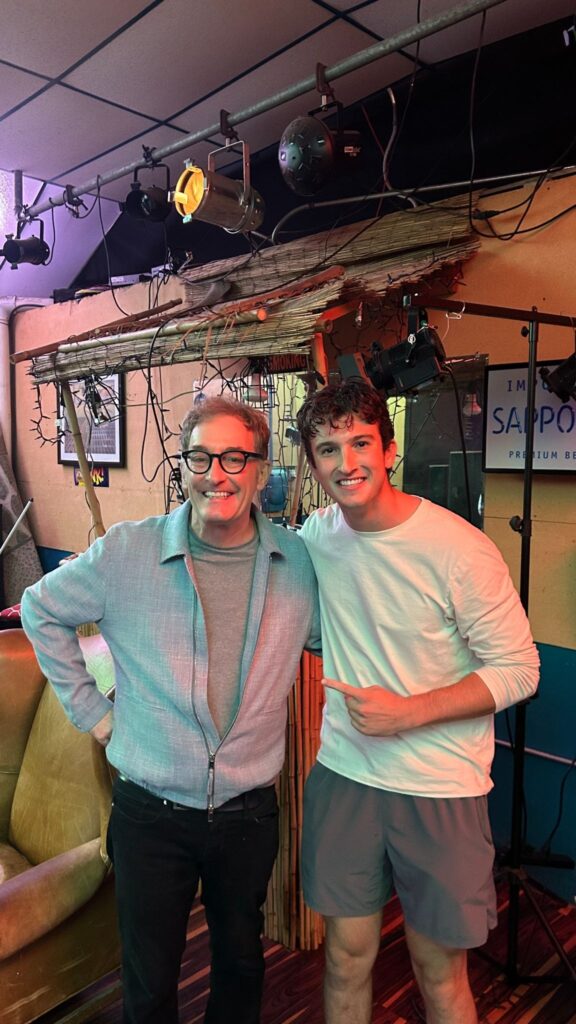


Connect with Tom Kenny and The Hi-Seas:
Interviewed by Jake Cousino @The Sonic Temple